
In the essay “The Characteristics of Negro Expression”, Zora Neale Hurston explains that, “the automobile is ranged alongside of the oxcart. The angels and the apostles walk and talk like section hands. And through it all walks Jack, the greatest culture hero of the South; Jack beats them all — even the Devil, who is often smarter than God” (1934, 5).
In Jack Kerouac’s seminal text On the Road, the semi-autobiographical narrator travels across America in search of meaning, freedom, and identity in the rapidly evolving, post-war nation. The text became a counter-culture bible, capturing the spirit of rebellion and non-conformity, in parallel to the emergence of suburbia and consumer capitalism in the late 1940s and early 1950s. On the Road was published on September 5, 1957.
One day earlier, on September 4, 1957, integration began for the landmark 1954 Supreme Court Ruling, Brown v. Board of Education. The Supreme Court had ruled that segregated education was unconstitutional; on that day in Arkansas, the “Little Rock Nine” attempted to enter Little Rock Central High School, only to be met by a mob of enraged protestors. The National Guard was brought in, not to protect the students but to turn them away. It was only after an executive order placed by President Dwight D. Eisenhower that the National Guard stood down and protected the students from the mob instead.
Published at the height of the Civil Rights Movement and exploring complex themes such as freedom, belonging in America, and counterculture, the contextual history and thematic explorations of On the Road are closely intertwined with the African American experience at the time.
Writing in the same time period as Kerouac, Hurston’s two essays “Characteristics of Negro Expression” (1934) and “What White Publishers Won’t Print” (1950) provide an interesting lens to analyze On the Road. Specifically, Kerouac’s aestheticization of Blackness and his complicated relationship between appropriation and admiration of Negro expression intersect with Hurston’s idea of Black “mimicry”. Furthermore, the novel’s stereotypical portrayal of not only Black characters but also all non-Anglo-Saxons can be critiqued by what Hurston describes as “The American Museum of Unnatural History”. Through these two points of specific comparison and racial criticism, Keroauc’s novel’s societal and literary positions as a countercultural text can be read as racially privileged. Ultimately, On the Road’s complicated depictions of Blackness reveal that even texts that are considered antagonistic to normative culture must still be read as intersectional.
Firstly, Kerouac’s textual and internal positioning in On the Road is that of an outsider in America. At first glance, the narrator Sal Paradise finds comfort in the freedom of travel and discovering new cities. For example, when he enters Los Angeles, he states, “I love the way everybody says ‘LA’ on the coast; it’s their one and only golden town” (Kerouac 2011, 74). Driving across the country, he makes frequent remarks such as “we were all delighted, we all realized that we were leaving confusion and nonsense behind and performing our one and noble function of the time, move. And we moved” (Kerouac 2011, 121) or other similar sentiments such as “all I wanted to do was sneak out into the night and disappear somewhere, and go and find out what everybody was doing all over the country” (Kerouac 2011, 60). Yet after bohemian exploration and ecstatic optimism, each city turns rapidly into a depressing scene of isolation; “I never felt sadder in my life. LA is the loneliest and most brutal of American cities: New York gets god-awful cold in the winter but there’s a feeling of wacky comradeship somewhere (Kerouac 2011, 77). In New York, he ironically states, “Suddenly I found myself on Times Square. I had traveled eight thousand miles around the American continent and I was back on Times Square… absolute madness and fantastic hoorair of New York with its millions and millions hustling forever for a buck among themselves, the mad dream — grabbing, taking, giving, sighing, dying, just so they could be buried in those awful cemetery cities beyond Long Island City” (Kerouac 2011, 96). From coast to coast, and even in Middle America — “I went to Denver, thinking of settling down there. I saw myself in Middle America, a patriarch. I was lonesome” (Kerouac 2011) — Paradise feels an intense isolation and detachment from the “mad” American dream; “Last night I walked clear down to Times Square & just as I arrived I suddenly realized I was a ghost – it was my ghost walking on the sidewalk” (Kerouac 2011, 163).
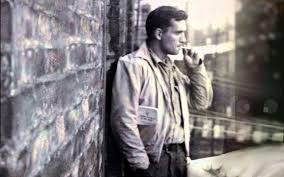
This idea is significant as the novel is figuratively creating this philosophical position of an outsider, all the while African Americans face literal and legal segregation. What makes this tension all the more fascinating and relevant to critical racial analysis is that Paradise is seemingly ignorant of the political position of Black Americans. In what is perhaps simultaneously the most damning and fascinating racial exploration in the novel, Paradise states:
“At lilac evening I walked… among the lights of… the Denver colored section, wishing I were a Negro, feeling that the best the white world had offered was not enough ecstasy for me, not enough life, joy, kicks, darkness, music, not enough night… strolling in the dark mysterious Streets… I wished I were a Denver Mexican, or even a poor overworked Jap, anything but what I was so drearily, a “white man” disillusioned. All my life I’d had white ambitions… I was only myself, Sal Paradise, sad, strolling in this violet dark, this unbelievably sweet night, wishing I could exchange worlds with the happy, true-hearted, ecstatic Negroes of America”. (Kerouac 2011, 164)
Clearly, Paradise associates the “happiness”, “life”, and “joy” that he seeks throughout the entire novel with African Americans while completely disregarding the political realities and oppression of the time. Not only is the narrator ignoring the material conditions of Black Americans, but suggesting that they are happier because of these “kicks” and “darkness”. Although Paradise acknowledges a distinction between his whiteness and the “Mexican”, “Jap”, and “negro” life, the binary is nothing but self-serving; this framing is approached through the narrator’s personal desires of “ecstasy” and “ambition”. Another example of Kerouac’s aestheticization of Black interior life is the line “Sighing like an old Negro cotton-picker, I reclined on the bed and smoked a cigarette. Dogs barked in the cool night” (2011, 22). Instead of associating cotton picking with the brutal, harsh conditions of slavery, Paradise imagines this life to be one of quaintness and uncomplicated idleness. Even when the segregationist laws are mentioned, they are only brought up to reinforce that these laws are restrictive on the free-spirit of the white, Beat characters in the text; “New Orleans is a very dull town. It’s against the law to go to the colored section. The bars are insufferably dreary” (Kerouac 2011, 133). By briefly visiting these physically segregated locations, Kerouac seemingly engages with the culture and the people outside of the dominant hegemony. However, these brief portrayals are only attempts to legitimize the text’s positioning as transgressive and are profoundly self-serving, failing to actually engage with Blackness beyond a superficial aestheticization.
Here, Hurston’s criticisms come into play at full force. Especially interesting is the paradoxes that an analysis through “Characteristics of Negro Expression” would provide. On the one hand, Kerouac’s statements are in complete accordance to the idea that, “Every phase of Negro life is highly dramatised. No matter how joyful or how sad the case there is sufficient poise for drama. Everything is acted out. Unconsciously for the most part of course. There is an impromptu ceremony always ready for every hour of life. No little moment passes unadorned” (Hurston 1934, 1). This dramatization of ‘Negro expression’ that Hurston celebrates is the very one that Kerouac seems to find to be “true-hearted”. The whole novel itself can be read through this lens; the semi-autobiographical nature of the text is a “dramatization” of Kerouac’s “joyful” and “sad” travels.
Hurston’s analysis aligns further in unexpected ways. More broadly, Kerouac is engaging in what Hurston describes to be “mimicry” in “Characteristics of Negro Expression”, She asserts that, “if we look at it squarely, the Negro is a very original being. While he lives and moves in the midst of a white civilization, everything that he touches is reinterpreted for his own use. He has modified the language, mode of food preparation, practice of medicine, and most certainly the religion of his new country” (Hurston 1934, 7). On the Road ends with the passage “So in America …all that road going, and all the people dreaming in the immensity of it…tonight the stars’ll be out, and don’t you know that God is Pooh Bear?” (Kerouac 2011, 281). Kerouac “reinterprets the religion of his new country” as “Pooh Bear” in an attempt to reconcile with the vastness of America in his own words and spirituality.
Even the plot of the novel can be seen as a reinterpretation. From the evocation of the pioneer expansion of the Manifest Destiny area of America, “I was halfway across America, at the dividing line between the East of my youth and the West of my future” (Kerouac 2011, 16), to the similarities to the Great Migration and wandering of freed slaves post-emancipation, “The following midnight, singing this little song, Home in Missoula // Home in Truckee // Home in Opelousas // Ain’t no home for me // Home in old Medora // Home in Wounded Knee // Home in Ogallala // Home I’ll never be. I took the Washington bus; wasted some time there wandering around; went out of my way to see the Blue Ridge, heard the bird of Shenandoah and visited Stonewall Jackson’s grave” (Kerouac 2011, 232), going as far as singing a Blues-like song and evoking Civil War imagery, Kerouac’s journey serves as a mimicry and remaining of the American traveler. In the brand new era of consumerism and freedom defined by a sparkling Cadillac, Paradise is forging a new path on a road already travelled; “You and I, Sal, we’d dig the whole world with a car like this because, man, the road must eventually lead to the whole world” (Kerouac 2011, 209).
The mimicry can also be applied to the theme of jazz in the novel. Kerouac’s stylistic adoption of jazz into his stream of consciousness writing can be seen as ‘mimicry’, while his framing of jazz as counterculture at times borders on the appropriative rather than appreciative. For example, he writes, “Holy flowers floating in the air, were all these tired faces in the dawn of Jazz America” (Kerouac 2011, 200), where Jazz America is conceptualized centrally through the “faces” of Paradise’s white friends, none of whom play jazz. To his credit, Paradise does explain his appreciation for black musicians such as Louis Armstrong, Roy Eldridge, and Charlie Parker, and it’s clear that their is a genuine appreciation for the art. However, a problematic depiction of jazz as simply a token substitution of the exotic occurs when Paradise’s friend has sex to the beat of a jazz record with a Black woman; “Dean was having his kicks; he put on a jazz record, grabbed Marylou, held her tight, and bounced against her with the beat of the music. She bounced right back. It was a real love dance” (Kerouac 2011, 120). Unfortunately, both Paradise and Dean go on to call Marylou a “whore” throughout the text, objectifying Marylou when she rejects their advances. Kerouac’s depiction of jazz straddles the line of mimicry and appropriation.
Of course, the underlying difference in these comparisons is that Hurston is explicitly examining “Negro life”, when — as much as he would desire to be different — Paradise is a white character through and through, and Kerouac is a white author. For Hurston, the necessity for mimicry is a result of the fact that Black Americans “lives and moves in the midst of a white civilisation” (1934, 7). Because of his privileged position in America, Paradise is unable to question the segregated road he navigates, and therefore, his depictions of Blackness fall short as an appropriation and aestheticization.
It is then interesting that a writer whose work relies so much on mimicry is understood in the American canon as radical and counter-culture. Hurston writes that “Langston Hughes is not considered a poet by this group (white audiences) because he writes of the man in the ditch, who is more numerous and real among us than any other” (1934, 7). Kerouac writes of a man who is frequently — literally and metaphorically — in the ditch, “I plodded along in the ditch” (2011, 94), yet achieved bestseller status with On the Road. Here, Hurston’s essay “What White Publishers Won’t Print” becomes another interesting lens to examine the novel. Particularly, Kerouac’s stereotyping of various non-Anglo-Saxon characters in the novel can be seen as participating in “The American Museum of Unnatural History”. Hurston describes this metaphorical museum as “an intangible built on token belief. It is assumed that all non-Anglo-Saxons are uncomplicated stereotypes” (1950, 2). In addition to the examples layer previously, Paradise reiterates problematic phrases such as “Secret Chinamen” (Kerouac 2011, 219) and “Indian chiefs wandering around in big headdresses and really solemn among the flushed drunken faces” (Kerouac 2011, 31) in a sea of stereotypes and generalizations. Considering Kerouac is writing a sweeping landscape of America, and the text’s immobilization as American canon, the tokenized portrayals of minorities in the novel show how even supposedly countercultural art can be “dedicated to the convenient ‘typical’” (Hurston 1950, 3).
Ultimately, while Kerouac’s exploration of freedom and identity in On the Road is poetic and existentially gripping, it becomes evident through Hurston’s critiques of “mimicry” and stereotyping that his representation of Blackness remains problematic. His romanticization of African American life and his appropriation of Black culture for his self-discovery reveal a racially privileged lens that, despite challenging societal norms, still participates in the systemic dynamics of cultural appropriation. As Hurston’s essays reveal, even texts hailed as transgressive require critical racial analysis to uncover the hidden ways in which they perpetuate dominant cultural narratives.
Works Cited
Hurston, Zora Neale. The Characteristics of Negro Expression. 1934.
Hurston, Zora Neale. What White Publishers Won’t Print. Negro Digest, April 1950.
Kerouac, Jack. On the Road Penguin Classics Essentials Edition. Penguin Books, 2011
 𓆰𓆪 Desolation Angel 𓆰𓆪
Leave a comment